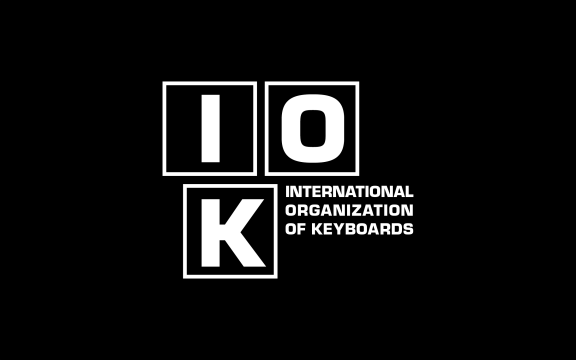
IOK is a concept branding project for an imaginary museum dedicated to the history, culture, and craft of mechanical keyboards. The project explores how a niche, passion-driven community could be represented through a cohesive, considered, and fully realized visual identity system — one that feels at home in both a museum context and the vibrant online culture surrounding the hobby.
The brand is built on a foundation of black and white — clean, authoritative, and museum-appropriate. This neutral base gives the identity a sense of institutional credibility while allowing the subject matter to speak for itself. Layered on top is an RGB highlight palette that references the backlit, customizable nature of mechanical keyboards directly. The RGB palette also enables gradient usage throughout the system, echoing the spectrum-shifting light effects that have become synonymous with the hobby. The result is a brand that feels restrained and serious when it needs to be, and vivid and expressive when the context calls for it.


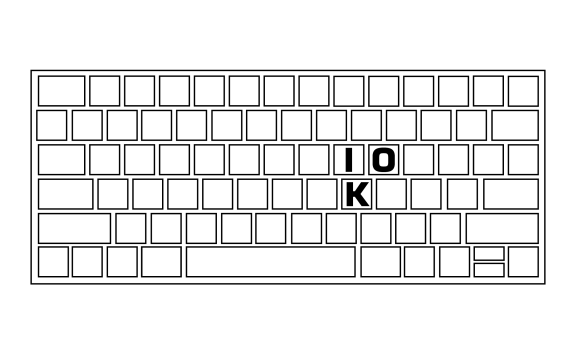
The logotype lockup is the heart of the identity. Its structure is drawn directly from the physical layout of a standard American keyboard — the letters I, O, and K are positioned exactly as they appear on a real keyboard, and each is enclosed in a box that references the square profile of a keycap. Nestled within the corner created by the key placement, the full museum name — International Organization of Keyboards — unpacks the acronym naturally, emerging from the structure of the mark rather than being appended to it. The simplified logotype strips the mark back to its three boxed letterforms alone, offering a flexible and equally strong alternative for smaller applications.


The wordmark presents the full name of the museum set in Eurostile LT Std Bold in all caps, fully justified across each line. The justification creates a structured, architectural quality that feels deliberate and contemporary. The final line is tracked out slightly to balance the spacing and ensure the mark reads evenly from top to bottom. Together, the logotype and wordmark form a system that is adaptable across a wide range of formats and scales, with clearly defined size thresholds and redrawn small-use variants ensuring legibility is never compromised.
The typography system is built around three carefully chosen typefaces. Eurostile LT Std Bold leads the system with a geometric, linear character that echoes the precision and industrial quality of mechanical keyboards. Source Sans Pro Regular serves as the on-screen body typeface — a humanist sans-serif designed for user interfaces, neutral and highly legible. Garamond Premier Pro rounds out the system as the serif option, bringing a classic, readable contrast ideal for printed legal and formal material. Together, the three typefaces cover every application the brand requires while maintaining a cohesive and considered voice.


The Keyboard Pattern extends the identity beyond the logo, adding texture, depth, and visual interest across the brand system. Derived from the layout of a computer keyboard, the pattern carries an immediate sense of familiarity for enthusiasts while remaining visually accessible to a broader audience. It can be used alongside the logotype or wordmark to build context, or deployed independently as a standalone graphic element on merchandise, environmental graphics, and editorial layouts.


IOK was an exercise in building a brand system that operates on two levels simultaneously — institutionally credible enough for a museum, and culturally fluent enough for a passionate and detail-oriented community. Every decision, from the keyboard-derived logotype structure to the RGB accent palette, was made with that balance in mind. The identity is designed to grow with the museum across print, screen, environmental, and motion applications without ever losing its sense of purpose or cohesion.
This project was designed entirely within the Adobe Creative Suite. The core identity and graphic elements were built in Adobe Illustrator, with layout and standards documentation assembled in Adobe InDesign. Adobe Photoshop was used for mockup compositing and image work, while motion and animation explorations were produced in Adobe After Effects. Three-dimensional elements and renderings were created in Cinema 4D. The full IOK Identity Standards document is available to download here, covering typography, color, logo usage, graphic elements, and brand application guidelines.